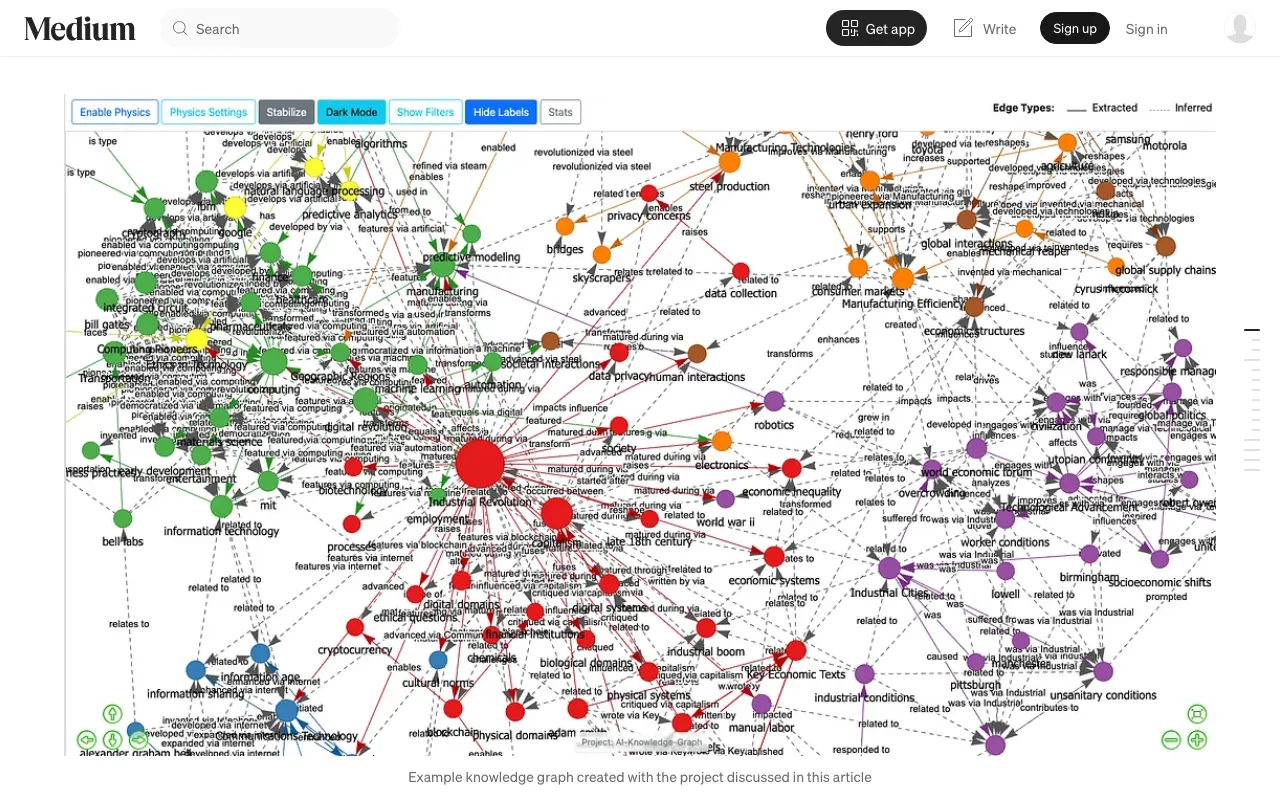
This system turns unstructured documents into typed subject-predicate-object graphs using an OpenAI-compatible LLM, then visualizes and queries them in the browser.
Overview
The product ingests unstructured text from formats such as plain text, Markdown, reStructuredText, PDF, and DOCX, optionally across whole directories and multiple languages. Large inputs are split on sentence boundaries with overlap, and chunks are processed in parallel to extract typed entities and relationships with source sentences attached.
A standardization pass merges obvious lexical variants and can optionally ask the LLM to align entities that refer to the same concept. Optional inference steps add conservative bridges between isolated graph components or well-known links among central entities, with each inferred edge labeled by method and capped relative to extracted facts.
Outputs include a self-contained interactive HTML explorer with search, highlighting, relationship panels, community names, filters, shortest-path lookup, and export options, plus JSON, CSV, GraphML, and Neo4j Cypher formats. The optional graph-chat command answers questions using only retrieved subgraph facts with citations, and graph-serve adds a local library UI with ingestion and the same Ask panel.
Configuration is TOML-driven with support for Ollama, LM Studio, vLLM, and other OpenAI-compatible providers, including response caching, truncation handling for reasoning models, and retry behavior. Sample graphs ship so exploration works without calling a model, while generation and chat require a configured endpoint.
Key features
- Parallel LLM extraction of typed SPO triples
- Entity standardization and predicate normalization
- Optional LLM and rule-based link inference
- Self-contained interactive HTML graph explorer
- Grounded graph-chat with cited facts
- Local graph-serve library and ingest UI
- Exports to JSON, CSV, GraphML, and Cypher
- OpenAI-compatible LLM endpoint support
Use cases
- Exploring themes in long documents
- Teaching or demoing knowledge graphs
- Tracing facts back to source sentences
- Neo4j or Gephi export from text
- Local Q&A over a generated graph






 Anthropic Claude
 ChatGPT
